Wednesday, July 31, 2013

More on freshness in response to a reader's comments

Patrick offered this comment and question:


About a year or so ago I went into Stumptown here in New York and they had the Panama Esmeralda Especial Mario San Jose. It was $100 for their standard 12oz. Was I going to shell out that kind of dough for it? You bet, I mean, I was curious. It was packaged in their same tie bags, only the bag itself was plopped into a large stylized ball jar with a cool font on it. I looked at the roast date and lo and behold it was about 10 days old. I asked the barista since it was so old if I could have it for half price (still an insane price). I couldn't have it at half price they told me and I wouldn't be surprised if that coffee ended up in the garbage. Talk about waste. 

The other day I was poking around on the Stumptown website and came across some of their freshness info: http://stumptowncoffee.com/support/faq/
Kevin, do you know what other roasters package their coffee correctly as you mention? I know Gimme uses valve bags, but I am unsure of the process.


The FAQ that Patrick provides the link to on the Stumptown web site is worth reading in its entirety, but here's the most important part:

FRESHNESS AND OILS
Fresh coffee will look dry, rather than oily. As coffee ages, the beans naturally secrete oils, losing some of the flavor nuances in the process. So, you want to be sure that coffee you purchase has a nice, dry surface. Also, darker roasted coffees excrete oils more quickly since the integrity of the bean is compromised by a longer roast which also diminishes the potential flavor nuances. Although a vacuum sealed bag will retain aromatics within the bag, as soon as the bag is opened, those aromatics are released into the atmosphere. A sealed bag does not allow natural degassing to occur in a way that helps maintain the integrity of the bean and the balance of the flavor profile over time. We prefer to strive to provide our customers with the freshest coffee possible and encourage our folks while it’s fresh to have the best drinking experience possible.

This text is a mixture of disinformation, obfuscation and outright unintelligibility. Let's break it down:

1. Fresh coffee could look dry or oily, depending on the degree of roast, ambient temperature and what it's packaged in. If the coffee is roasted to second pop the cell walls have been broken and the coffee will eventually bloom oil, but store such coffee at cool room temperatures or in the fridge or freezer and it will assume a matte finish as the oils retreat into the bean. Conversely a lighter roast will "sweat"oils if the coffee is packaged in a tightly sealed bag and shipped or stored in warm temperatures. 

As for "a longer roast which also diminishes the potential flavor nuances," that all depends on what brewing method you're using, which coffee you're roasting and which aspects of the coffee's character you want to showcase. City to Full City roasts of high-altitude washed Central American coffees are great for drip or vacuum pot expression of acidity and aroma, but body is thin and under-developed and such coffees are poor choices for moderately-pressurized brewing methods like Aeropress or French Press and atrocious for espresso, which due to its high pressure extraction elevates the acidity of such coffees to fresh-squeezed lemon juice levels. 
Plus - though you'd never know it from many Third Wave coffee menus - there are great coffees grown on other continents and processed by other methods, and light roasts are terrible for Indonesian coffees or the great naturals from Ethiopia, Yemen, Brazil or anywhere else. 

2. "Although a vacuum sealed bag will retain aromatics within the bag, as soon as the bag is opened, those aromatics are released into the atmosphere."
This is a murky sentence, but it sounds like what they're trying to say is that valve bag coffee somehow mysteriously "catches up" to its chronological age when the bag is opened - the coffee equivalent of Cinderella staying too late at the ball. That's even more of a fairy tale than Cinderella, but meanwhile what we do know for sure is that coffee sitting on the shelf in a tie tie bag is oxidizing by the minute. 

3. "A sealed bag does not allow natural degassing to occur in a way that helps maintain the integrity of the bean and the balance of the flavor profile over time. We prefer to strive to provide our customers with the freshest coffee possible and encourage our folks while it’s fresh to have the best drinking experience possible."

Here we have a first sentence made up of total bullshit followed by one that's actually incomprehensible. The whole point of a properly vacuum-sealed and nitrogen back-flushed Fresco or other one-way valve bag is that is allows natural degassing to occur but slows the rate of staling to a glacial pace, resulting in coffee that is indistinguishable from just-roasted samples of the same coffee for 8-12 weeks from roasting when tasted by a panel of expert tasters. (I'd be remiss if I didn't point out that roasters who claim 6-12 months of shelf life, basing their standards on what they can get away with rather than excellence, are just as far removed from authentic specialty coffee as the tin tie bag Luddites). 

To be clear, I'm no fan of valve bags or pressurized containers a la Illycaffe. The ideal is to to exactly what we did at Starbucks from 1971 through the mid 1980's: roast everyday, deliver to the stores three times a week in reusable cans or bins, allow the stores to order every coffee in 2 pound increments and mandate that every bean be sold or brewed within one week of roast. The advantages of this approach are legion: you avoid the ecologically-disastrous ocean of un-recyclable laminated material used in valve bags, everyone involved in the business is kept keenly aware of coffee's highly perishable nature, you're prevented from successfully engaging in the deal with the devil that is called wholesale since you have no way to sell ground coffee except very locally and - last not least - your brand is effectively limited to a truly local size, keeping it human scale. 

Once you decide to open stores in multiple cities and/or expand aggressively through mail order and wholesale you've eaten much fruit from the tree of knowledge and have long since been exiled from the Garden of Eden into a world where you have to have packaging capable of extending your coffee's shelf life. 

One of the co-founders of Starbucks once famously said (paraphrasing) "ideally we want to be responsible for our coffee from the moment the tree is planted until the moment the customer finishes the last sip." How far we've regressed when being "passionate" about quality means having the GPS coordinates of the farm on a bag that does nothing to protect its contents from staling, and then using New Age nonsense to justify a Luddite approach to packaging, grinding and the like.

As to Patrick's last question about who uses valve bag packaging properly, I can vouch for Peet's, Allegro, Starbucks, Gaviña and any number of other larger companies, but (without naming names) I've been shocked to see many Third Wave places not only just heat sealing pre-made valve bags, but also putting coffee in 'em that has been sitting around in bins for days first, grinding coffee for restaurant accounts not in the water-cooled roller mill grinders used by professionals but in Ditting or Bunn grinders intended for pound-at-a-time retail use that get hot enough to fry an egg (and ruin aroma) when mis-used commercially, blending back in weeks old whole bean coffee pulled from supermarket shelves on and on.

As I've sad before quality is only meaningful when its objective, measurable and includes parameters for every part of the chain of custody of coffee from tree to cup. A myopic focus on one or two aspects of the process combined with willful ignorance of the rest does not constitute progress. 


Friday, July 26, 2013

Two points of entry into the original taste of coffee, two generations of roaster-retailers


I just finished spending 4 days in Portland, Oregon and am now visiting family in northern Washington State. While I was in Portland I hung out at Stumptown and at owner Duane Sorenson's wonderful new bakery, called Roman Candle, whose world-class pastries are now found at both the bakery and Stumptown stores.

I tasted a bunch of coffees at Stumptown, and the stand-out among several impressive coffees was this Ethiopia Chelbassa Yergacheffe, a reference-standard coffee of a caliber I haven't tasted in many years. When I got home I had a mail order from Peet's awaiting me that included several pounds of their limited edition Ethiopia Queen City, a full-throttle Harrar that's just as classic as the Yergacheffe, though obviously the processing of the bean and the roast could hardly be more different.

Tasting these two great coffees offers the opportunity for several reflections that feel timely to me, especially given what I've seen going on with roasting, particularly, where I'm seeing more and more production roasts that are actually too light for cupping, let alone sale to consumers, while fully-developed classic full city roasts have become hard to find. To be clear, I'm not talking about Stumptown here, which has sourcing capabilities and precision in their roasting that put them head-and-shoulders above most smaller players.

First, some specifics about these particular coffees. I bought the Chelbassa at the original Stumptown store on SE Division Street. It was roast-dated four days prior to my purchase, in a 12 ounce plain tin tie bag, and it cost $16.50 for 12 ounces, or $21.92 per pound. The Peet's was $15.95 for a full pound, roasted to order, vacuum packaged and nitrogen back-flushed, to order, in a Fresco valve bag, with free shipping due to the promotion going on at the time.

The roast on the Yergacheffe is classic City - probably in the high 70's on the Agtron scale. The Harrar meanwhile is full-on Peet's deep roast....an educated guess would put the Agtron number (all of these are for ground, by the way) in the high 30's to low 40's.

The Peet's, roasted on July 11th and opened on the 23rd, was, unsurprisingly, the fresher of the two coffees, and would of course have remained so unopened for another 8 weeks or so. That might seem irrelevant, but the more sophisticated packaging enabled me to order more of a rare coffee than I otherwise would have been able to use, which certainly benefited both Peet's and me.

The Stumptown Yergacheffe is dazzlingly aromatic, with notes of lemon, jasmine and lavender and mouthwatering acidity. It's at its best in a vacuum pot or perhaps better paper filter drip, to mute the screaming acidity a bit.

The Peet's Queen City is just as aromatic, but we're talking blueberry, chocolate, matured Virginia and Latakia pipe tobacco and a shelf full of Asian spices. The roast calls for Aeropress or French Press, or a commercial espresso machine for the truly daring.

These two coffee types - manicured washed and well-chosen natural - of Ethiopian coffee, together, represent the original taste of coffee altogether, from the Motherland. They deserve a lot of respect - reverence, even - from coffee professionals and connoisseurs alike.

I liked both coffees equally, but I can only think of a handful of coffee professionals I know who are capable of appreciating both of these coffees at their respective degrees of roast. Savvy consumers could certainly appreciate both coffees, but good luck to them finding them, as washed Ethiopians in the style of the Stumptown coffee here (though admittedly not at its quality level) are now commonplace among Third Wave roasters, while great  naturals like the Peet's Harrar are exceedingly hard to find.

As a consumer now rather than a green coffee buyer who gets to take home the best for free, I feel obliged also to draw your attention to the big difference in price, which pertains not just to these two coffees but to coffees in general at top Third Wave roasters vs. all other sources of whole bean coffee. The Stumptown coffee is over 25% more expensive than the Peet's, which in addition to being cheaper is far better  (and much more expensively) packaged, and undergoes 5-7% more shrink during roasting. A Kenya Auction lot from Stumptown from the same visit was $22.50 for 12 ounces - nearly $30 per pound, while a pound of Peet's Kenya Auction Lot bought at the same time as the Ethiopian was $16.95, and the two coffees were of roughly equivalent quality.

To give credit where it's due, the use of Grain Pro packaging and expedited shipment, especially of African coffees, is a very real and tangible improvement in quality that Stumptown and other top Third Wave roasters deserve credit for helping to make happen, and it costs money. Nevertheless, that improvement certainly doesn't mean that the overall quality of coffee being bought at Third Wave places is better than what Peet's, Illy and several other sizable companies have been doing for decades.

More microlots, more marketing, farm travel and the like cost serious  money, but so does packaging coffee so that it stays fresh for months rather than days and brewing it properly in precisely-calibrated drip equipment in-store (as Peet's does and today's Third Wave folks generally don't). Whole bean freshness and precision brewing of all the coffee (not just espresso shots and latte art) are a vital part of getting the quality the farmer worked hard to achieve into the cup of the consumer who pays the bills. Total quality - not just that of incoming green - and value-for-money spent are also decisively important. So, too, is having a reasonable number of coffees to choose from, and there were exactly seven single origin coffees (four washed Centrals, 2 washed East Africans and one Indonesian) at the store I shopped in in Portland, vs. 12 at Peet's representing all three great growing regions and the full range of washed, semi-washed and natural processing methods.

Having bent over backward to give credit where it's due to Peet's I'll end by saying that the overall experience at Stumptown is far more enjoyable and of a piece. Stumptown is asking - and answering - the question "is it as good as the coffee?" - about architecture, brewing equipment, pastry, serve ware, training, education and everything else going on in the store carefully and in the affirmative, which results in a sense of trust in an ongoing commitment to excellence and continuous improvement that Peet's had decades ago and has long since lost in pretty much every area other than buying, roasting and in-store brewing. Here's hoping Stumptown can keep it simple and great as they grow, and that more diversity in origins and roasts come to pass as the Third Wave evolves.


Wednesday, July 17, 2013

Good article on capsule espresso systems in Coffee Review

Ken Davids has this excellent article comparing capsule-based home espresso systems from Starbucks and Keurig with Nespresso, the market leader. The short summary is there is no comparison - Nespresso remains the gold standard.

Where the article falls short, in my opinion, is in looking realistically at alternatives for the consumer who'd like to enjoy espresso-based drinks at home. Davids mentions a minimum ante of $700 for a home espresso set-up, but clearly a decent doser-grinder and a machine capable of producing the high pressure and precisely controlled temperatures required is going to cost more like 2-3 times that amount, plus of course entailing either previous training on commercial equipment or a lot of trial-and-error.

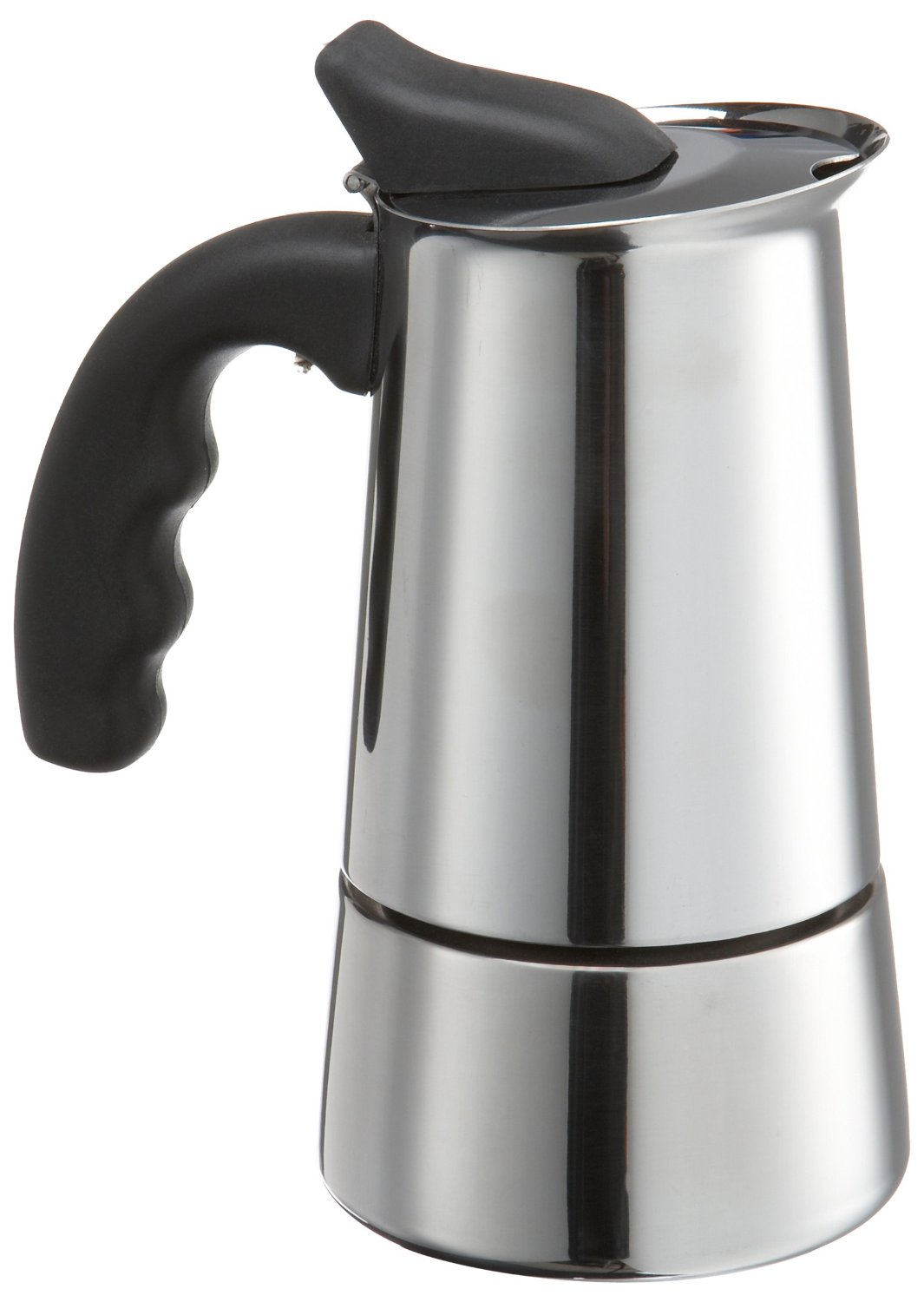
For the rare consumer who drinks primarily straight espresso it's probably worth it to just buy a small commercial machine and grinder, but for the other 98% who just want a tasty caffe latte or cappuccino in the morning there two time-tested alternatives that work a whole lot better. The first is a stainless steel stovetop espresso maker like this one:
Add a decent conical-burr grinder like Bodum's for around $100 and a stovetop milk frother ($40) and you have a simple, durable way to make very good drinks for under $200 total invested. Most people have no idea just how formidable a cup these stovetop machines can make. It takes attention and skill, but by using a fine (but not commercial espresso) grind, tamping the basket tightly (use a water glass) and above all watching the brewing like a hawk and turning the heat off once the coffee is flowing into the top (and long before it gets overheated) you can, with truly fresh (a week or less from roasting) coffee get results from one of these machines that are far superior to what you'll get out of any capsule machine, and better than a lot of espresso made on commercial machines by less-than-optimally-skilled baristas. 

For less hassle still, more versatility (since it makes superb drip-strength coffee as well) and lower costs, get an Aeropress ($25) and the same stovetop steamer. You can even get by with a blade grinder in this case, though a burr grinder is certainly superior. Using a heaping Aeropress scoop of beans per shot of espresso-strength coffee you can brew a very tasty cappuccino in minutes. 

Better still, take a chunk of the hundreds of dollars you just saved over both a true espresso machine and a lifetime of 70 cent a shot Nespresso mediocrity and invest it in a Behmor roaster and some great green coffee from Sweet Maria's. You'll soon be drinking better, fresher coffee than you can buy from almost any roaster-retailer, and at a fraction of the price. 


Monday, May 27, 2013

Criterion Coffee & Tea comes to an end

Thanks to Andrew Barnett for sharing this short article about the closing of San Francisco's legendary Freed, Teller & Freed after 114 years in business.

For those unfamiliar, Freed's had a small but lovely retail store on Polk Street for many years and a much larger wholesale business. Like so many others before me, I went there to buy some coffee and tea and ended up getting an education:  in coffee, tea, brewing, passion, authenticity, value-for-money and understated good taste.

I can't remember who originally told me to make the pilgrimage to Polk Street. It  might have been Mike Spillane from the wonderful tea importer G.S. Haly & Co. The aroma of freshly-roasted coffee was of course captivating, and (this would've been in the early 1980's) it was the first time I'd seen what I would later realize was classic Full City roasted coffee: even chestnut brown with no oils, the peak expression of flavor and aroma. They had real Yemen Mocha, and Mocha Java that was the antithesis of the mucho jiva being purveyed elsewhere, and vacuum pots, and Zassenhaus grinders - and people eager to tell you just how to use all of the above!


Then there was the tea, which I soon learned was the deepest passion of owners Augie and Karen Techeira. Single-garden Assams, painstakingly selected Ceylons and, usually, Hao Ya A (or B when it cupped better) Keemun, the finest Chinese black tea available. It was only much later in my coffee and tea career that I gained enough experience to realize that the selections on offer at Freed's were the product of a level of cupping and sourcing expertise that a newcomer like myself would most likely be unable to approach in a lifetime no matter how hard they were willing to work.

Nowadays the origin of great (I can't bring myself to say "specialty" since the S.C.A.A. has made the word into a guarantee of nothing but inflated price) coffee on the West coast is credited to Peet's, but Mr. Peet learned many of the ropes during his stint as an employee at Freed's, which had been offering great coffee for over half a century at the time. This isn't to take anything away from Alfred Peet, whose passion for excellence and superb palate would have made an impact no matter what, but merely to acknowledge that said passion and the insistence on equal billing for tea and coffee had deep roots.

Over my years at Starbucks and Allegro I'd run into Augie Techeira at trade shows, or talk to him on the phone from time to time (mostly when I was in desperate need of some great tea, or feeling particularly down about the state of the industry). So often I'd be looking at Freed's current price list and would see retail prices for coffee and tea that were roughly on par with what better-known roasters were charging their wholesale customers. I'd order some samples and maybe talk to Augie or Karen on the phone and would invariably discover that because they were buying on cup quality alone they'd rejected expensive and supposedly prestigious coffees and teas their less knowledgeable competitors had happily overpaid for, and were passing on the savings to their customers. In today's environment of $7 cups of under-roasted, often poorly-selected single origin coffee (served with a hefty dose of attitude on the side) it's hard to imagine that there once was a business to be had in selling people great coffee and tea to enjoy at home everyday, but there was.

From the article I opened with there's this explanation of why Freed's is finally closing:

 “they are unable to find suitable business successors that would meet their standards, and the customers’ standards."

Now I still recall being very impressed during my early years at Starbucks when the founders said (and meant) that they'd rather be out of a given coffee than substitute a lesser grade, but here we have a business that's been around for over a century that would rather close than inflict a watered down or corporately co-opted version of itself on its customers. 

How do you build a brand that can last a hundred years? When you say "quality without compromise" do you mean it, and if so do you mean it just for employees and farmers, or do you include customers in the equation to such a degree that you'd rather shutter your doors than bilk them? All worthwhile questions to ponder as we mark the end of the real beginning of great coffee and tea in America. 


Saturday, May 18, 2013

Traceability, Certification & Elitism

I just finished reading this excellent article in the New York Times. It's inspired by the tragic garment factory collapse in Bangladesh, but the implications are much broader, and of course I naturally thought of coffee when I read this:

"Mysterious origins are a hidden cost of cheap things....To have money today is often to acquire the right to know which person knitted your sweater or which farm bred the pigs in your chorizo. To be without money is to buy from a placeless netherworld and to be told to take it or leave it, no questions asked. 

It's a strange reversal. For most of history, the poor would have eaten the local pigs and known the origin of their socks, and the rich had better access to a global marketplace. But changing elite tastes and the relentless efficiency of supply chains have slowly inverted tastes: In many categories, the poor now buy from the exotic unknown, and the rich insist on what can be traced..."

My friend Tim Castle wrote recently about the sloppy surface-skimming that characterizes media coverage of various coffee certification schemes, but in my view he (uncharacteristically!) doesn't go far enough in the case of the Fair Trade and Organic certifications, which are rife with corruption and abuse. More interestingly still is what, if I'm not misreading it, looks like an unqualified endorsement of the so-called Direct Trade model. 

Returning to the themes raised in the Times article, here's a representative single origin offering from a highly-touted Third Wave roaster. The asking price - nearly $28.00 per pound* is quite typical of their offerings. 

Now considering that many estimable specialty coffee companies are profitably selling stellar single-origin coffee for $14.00 or less per pound, one wonders what the pie chart disclosing exactly who gets what from the $28 (which presumably any self-respecting Direct Trade roaster would be happy to share as part of their much-touted transparency and fairness ethos) would look like. It certainly doesn't have to do with "direct" trade per se as larger companies like Starbucks, Peets, Illycaffe and the like trade much more directly (that is to say, with fewer intermediaries needed and no need for exporters to act as tour guides and educators or importers to act as banks and shipping facilitators) than do smaller players who aren't buying all of their coffees in full containers. Maybe it's the cost of amortizing all of those farm visits, glossy web sites and Cup of Excellence bids over so few pounds that accounts for the doubling of costs to the consumer.....

More to the point though, this kind of pricing drives home with a vengeance the idea that artfully-roasted coffee is a luxury item for special-occasion consumption only - unless you are rich. And while the Times piece focuses primarily on clothing, the effects of a luxury pricing strategy on an extremely pershisable product tend to be more disastrous, in that the odds of it being sold stale are greatly increased. I still vividly recall being struck at the modest prices, quick turnover and shared sensibility about ripeness and quality I saw at cheese mongers all over France, followed by the jarring contrast of seeing the same cheese at triple or quadruple the price at my local Whole Foods, often in sorry condition, and of course not selling because at the price, and with no sampling or educational effort, a vital everyday foodstuff had been turned into a luxury buy. 

At the end of the day, I think there's more to be learned and emulated from the truly vertically-integrated approach of Brazil's Café Bom Dia than from any of the current crop of elitist roaster-retailers. Perhaps the "Fourth Wave," when and if it occurs, will be based on farmers deciding what constitutes fair and/or direct trade and taking the means of production and adding of value into their own hands. 


* They've chosen to set retail prices in grams [coffee worldwide is bought by pound] - which is at least more original than the dominant Third Wave pricing strategy of charging a usurious full pound price for a 12 ounce valve bag. 


Tuesday, May 14, 2013

Have it our way


I'm dating myself by even remembering the old Burger King "have it your way" ad campaign, but it's clear that the title of this post is what seems to excite Oliver Strand, the New York Times coffee columnist who like the Third Wave retailers he gushes over is usually long on style and short on substance. 

Today's fluff piece celebrates the opening of two very expensive coffee shops in New York (the epicenter of the culinary and caffeinated universe in case you're unfortunate enough to live in one of the flyover States): 

Some comments interspersed between quotes from the article: 


When Starbucks installed its first espresso bar in downtown Seattle, in 1984, it effectively reordered the hierarchy of coffee in this country: brewed coffee might be nice, but nothing beats the theater of a latte.

Superb drip coffee was an integral part of this presentation, along with espresso, cappuccino and caffe latte (sans caffe you're ordering plain milk). Moreover, Il Giornale, the Italian-inspired espresso bar that Howard Schultz started using Starbucks coffee, cared so much about getting the actual taste of coffee to its customers that it had a proprietary coffee-on-tap system that allowed the brewing of three varieties of drip coffee simultaneously during the morning rush, with two different single-origin coffees on offer every day. 

Today, many coffee nerds feel differently. Espressos are tasty, and a cappuccino is a pleasurable indulgence, but the real magic is found in a cup of black coffee prepared to order with beans from the latest harvest: the new crop of Central American coffees that is arriving now, and East African coffees that will be here come summer. When members of this generation of fanatics step up to a brew bar, it’s not to look for something familiar and comforting; it’s to try something new.
This is narcissism at its finest, which it to say its most unwitting and unselfconscious. The top new crop coffees from Central America are typically shipped (but not drunk) from April through June, but the same is true of the best Kenyans and Ethiopians. "Seasonality" is really code for "coffees from places we like to hang out."

More to the point though, who are these "coffee nerds who feel differently?" Oh, I get it: they're the nerds behind the bar, since the hapless customer supporting all of this narcissistic snobbery just wants their espresso drink or excellent cup of drip coffee so they can go about their lives. The "fanatics" are behind the bar and in the office,  busily jotting down the GPS coordinates of farms they've visited and writing coffee descriptions so over-the-top that one would think that psychedelic drugs must be incorporated into the brew water in the cupping room. 

The brew bar is as much a workshop as it is a place to get a coffee and buy some gear. There will be demonstrations, free cuppings and an easy flow of jargon-laced conversation. If you want to learn how grind size affects extraction, here’s your chance.

Wow how exciting. You know jargon-laced conversation and a bunch of snobs discussing how grind size affects extraction is just what I'm looking to pay top dollar for at 8 in the morning. 

“When the morning shift comes in at 5:30 a.m., they’ll cup the coffees,” said Mr. Morrissey, who won the prestigious World Barista Championship when he was working for Square Mile Coffee Roasters. “Then they’ll pick how to make it. It’s not that one brewer is better than another brewer. It’s that they might decide, ‘I’m loving the toffee notes in this, I bet it’ll be awesome in a Cafe Solo,’ ” he said, referring to a kind of brewer.
Not all brew methods are created equal. Some use thick paper filters that create a cleaner cup, others perforated metal filters that let through the oils and fine sediment that create a richer texture. A dripper might be shaped like a cone (the V60) or a wedge (the Bee House) or a cup (the Wave). The details can make a difference. Even if there’s no one right way to prepare coffee, different methods lead to distinctive flavors

That's a Venti of narcissistic drivel for sure, but hey a world-champion slinger of caffe lattes is the same thing as an actual coffee expert these days anyway, so who are we to question? 
What's far more important than the arcane differences between a bunch of single-cup drip brewers that are meant for home use and yield commercially meaningless amounts of tepid, papery drip coffee is that a properly calibrated satellite brewer or urn, using the same coffee, will yield a hotter, better-extracted and far more flavorful cup of coffee in quantities that meet the demands of the morning rush and that can be sold profitably at the kind of reasonable price that makes great coffee an everyday event rather than something that's reserved for the rich or for special occasions. 

The thoroughness of the disconnect between dicking around for a living behind the counter and the folks trying to make one who support the whole sorry show is that brewing methods that actually do translate to the home are not even in play here: no Bonavita or Brazen drip brewers, Aeropresses or French Press brewers. 

Maybe this is a sign that all that's old truly does become new again. Clearly Manhattan is in need of a chain of stores that offers a locally-tailored equivalent to Peet's Vine Street circa 1966, with fabulous 8 ounce cups of drip coffee being poured from the 3 gallon urn at 50 cents (adjusted for inflation - say $1, or $1.50 for those stuck paying New York rent) a pop. That's a concept I'd actually invest in. 

Friday, April 26, 2013

Replaces both your Hario and your Linea.....

Well this is exciting: a time-honored single-cup brewing method that surely has the ability to replace both espresso and tortuously slow yet breathtakingly overpriced single cup drip brewing in just about every Third Wave coffee venue. Make sure to check out the groovy instructional video:

http://sprudge.com/cezve-ibrik-ceremony-coffee-turgay-yildizli.html


My only complaint is they're not using the ideal soundtrack song:

http://www.youtube.com/watch?v=KCdKBHdPz30